
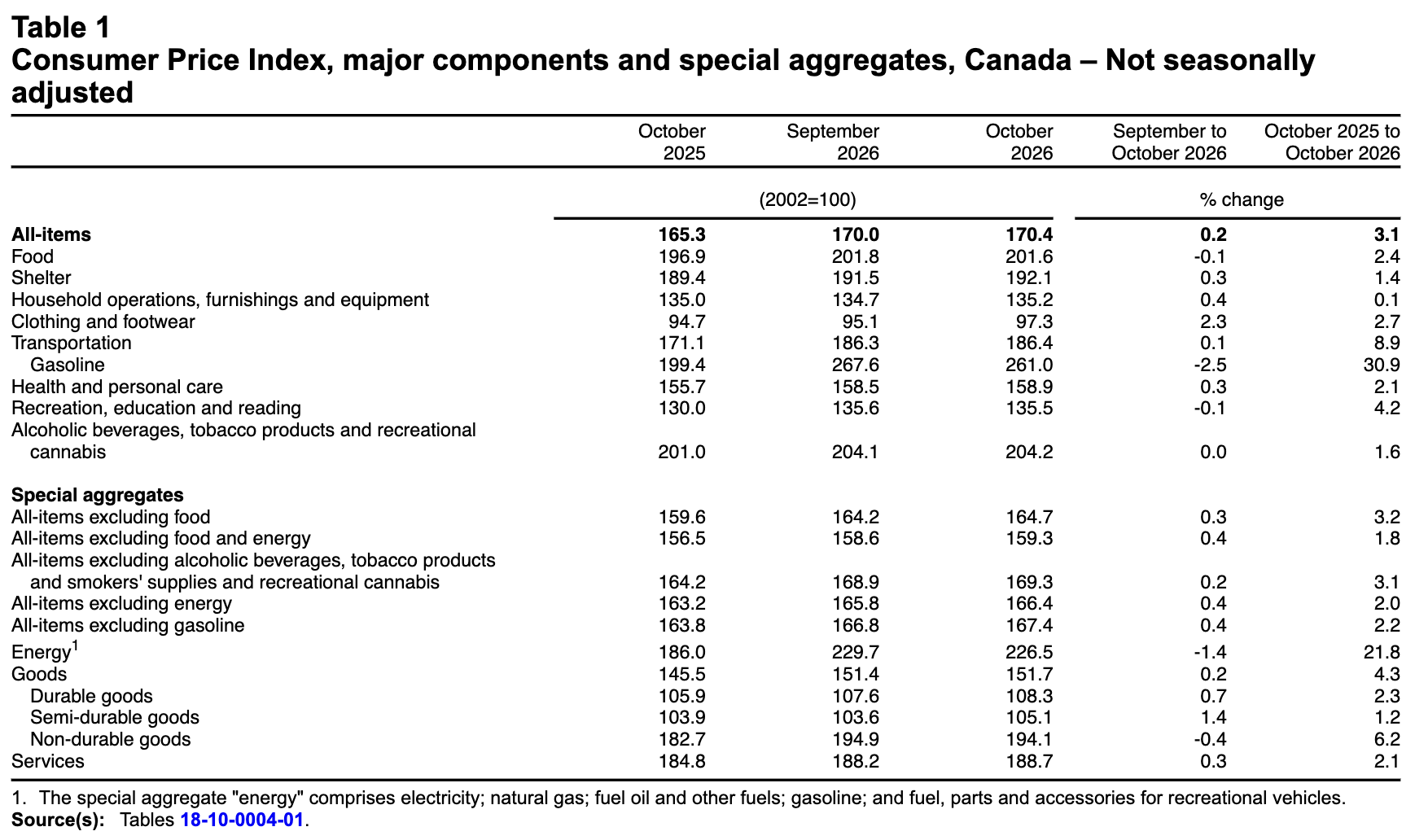
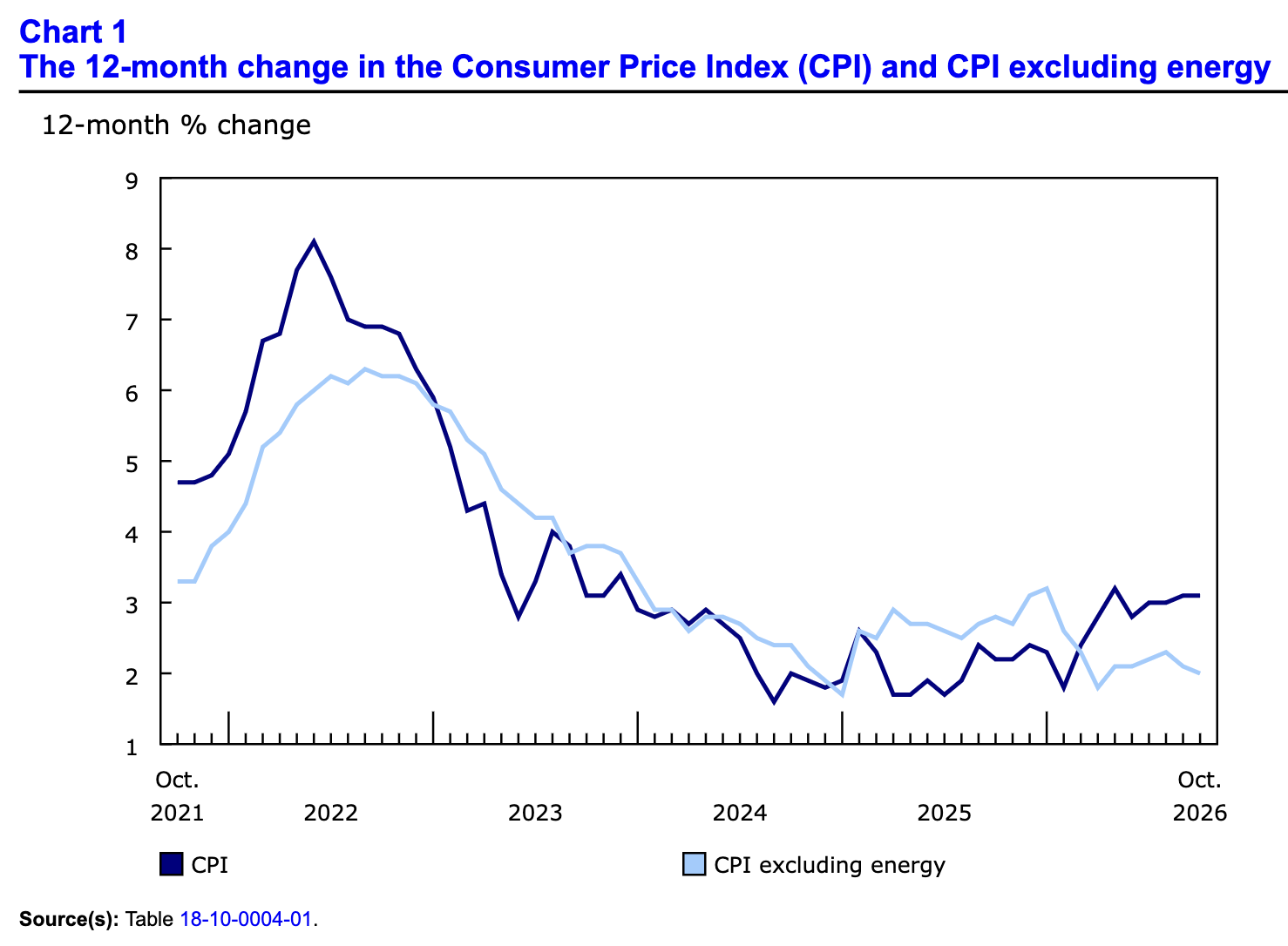
Canada’s consumer price index (CPI) increased by 3.1% year over year (Y-o-Y) in October, matching the 3.1% print from September. Statistics Canada (StatsCan) published the data at 8:30 a.m. ET on November, 16, 2026, via The Daily report. On a monthly basis, the CPI rose by 0.2%, with the acceleration driven by a mix of “higher prices for natural gas, gasoline, groceries, and clothing.”
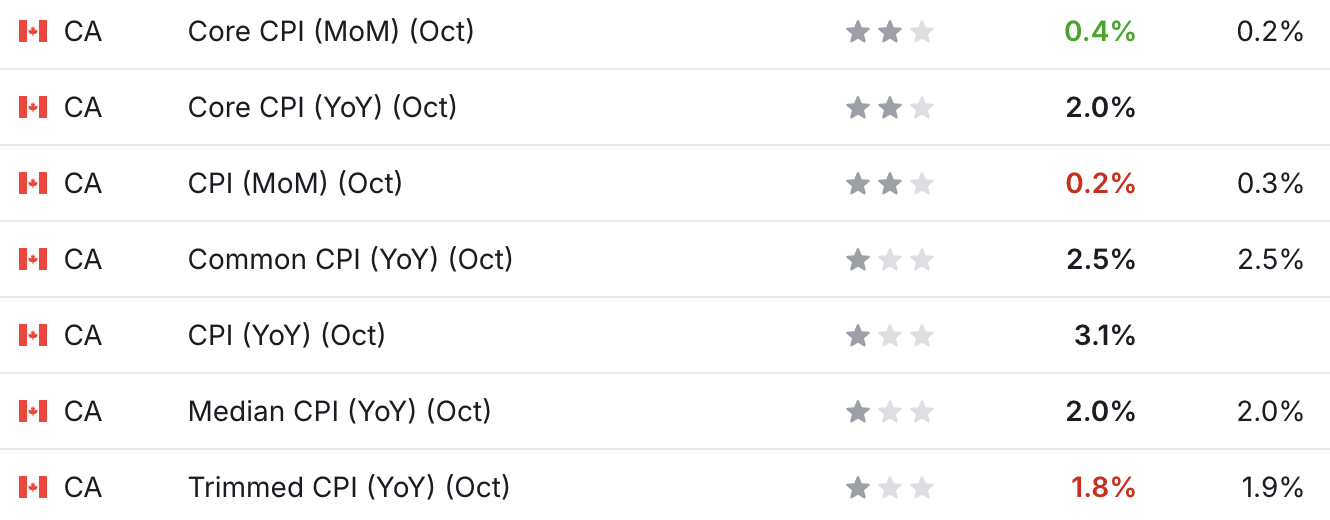
However, the results were also mixed relative to economists’ expectations. The table below is courtesy of Investing.com. The left column represents October’s figures, while the right column represents forecasters’ consensus estimates. As you can see, the core CPI was stronger than anticipated, while some other metrics were weaker.
Yet, after raising the overnight lending rate at the latest Monetary Policy Meeting, Bank of Canada Governor (BoC) Tiff Macklem struck a more balanced tone during the October 28 press conference. He said:
“With elevated inflation expected to last longer and the economy showing resilience, Governing Council agreed that risks to inflation had increased and there was less scope for monetary accommodation. Looking ahead, Governing Council agreed we would take future decisions one meeting at a time. There could be a need to raise the policy rate further, but given the uncertainties, we will proceed carefully.”
Thus, while higher oil prices continue to haunt the BoC, economic uncertainties may prevent rates from moving much higher.
Core CPI
Core measures of the CPI were also mixed in October, with the CPI-common index rising to +2.5% (from +2.4%), the CPI-median holding at +2.0% (from +2.0%), and the CPI-trim falling to +1.8% (from +1.9%). These measures exclude the impacts of food and energy, and the BoC places heavy emphasis on core measures because they provide a smoothed distribution of overall inflation.
Please note that food and energy prices are highly volatile and price spikes can occur for reasons outside of the BoC’s control. In contrast, core inflation is mainly driven by consumer demand and gives the BoC a better sense of how the Canadian economy is functioning.
Sector Results
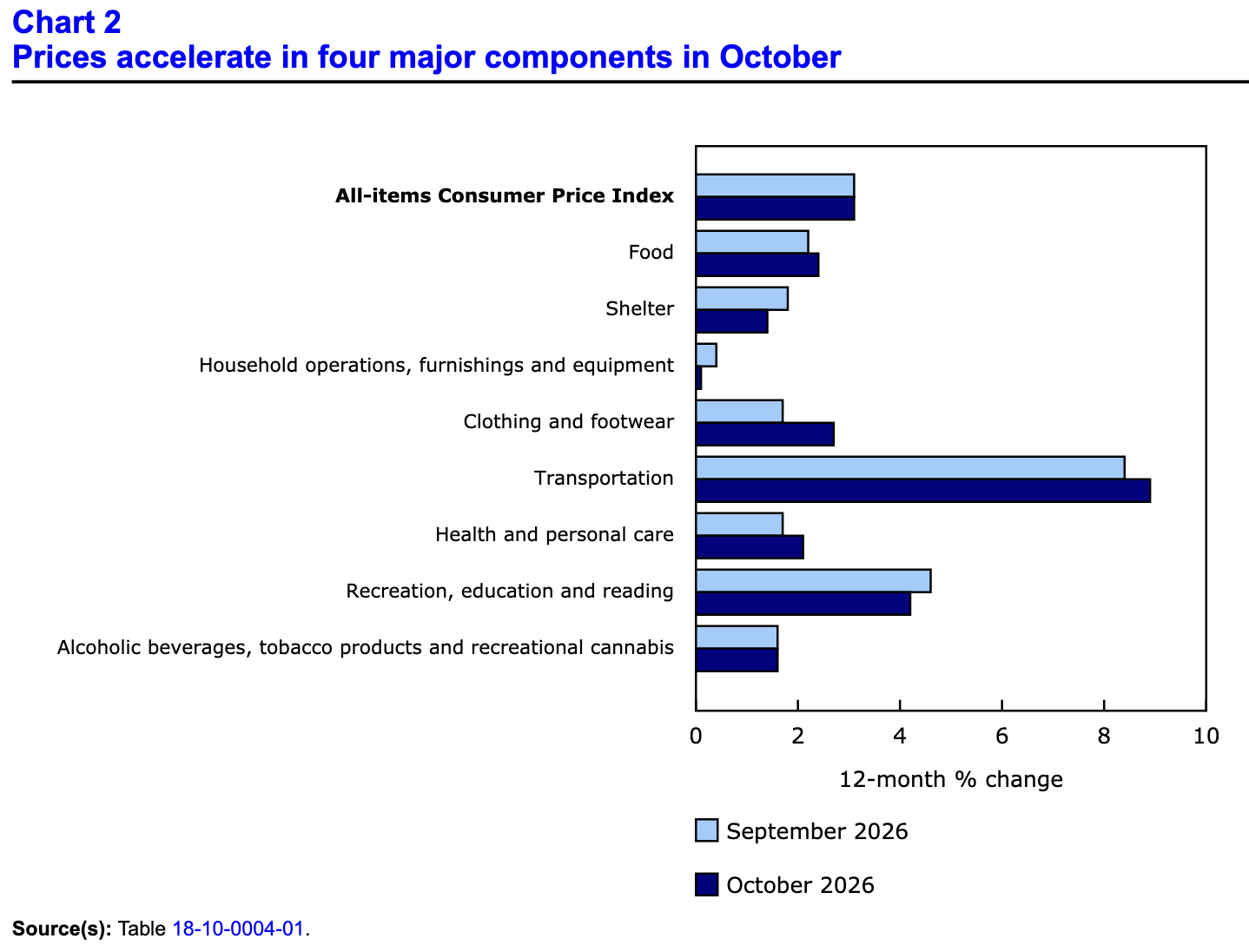
Sector performance was mostly well-behaved in October, with four sectors outperforming their September comparables. Food, clothing, transportation, and health/personal care were the leaders Y-o-Y, while shelter and household items were small laggards.
For context, the eight sectors include food, shelter, household operations, furnishings and equipment, clothing and footwear, transportation, health and personal care items, recreation and education expenses, and alcohol and tobacco products.
Food Inflation
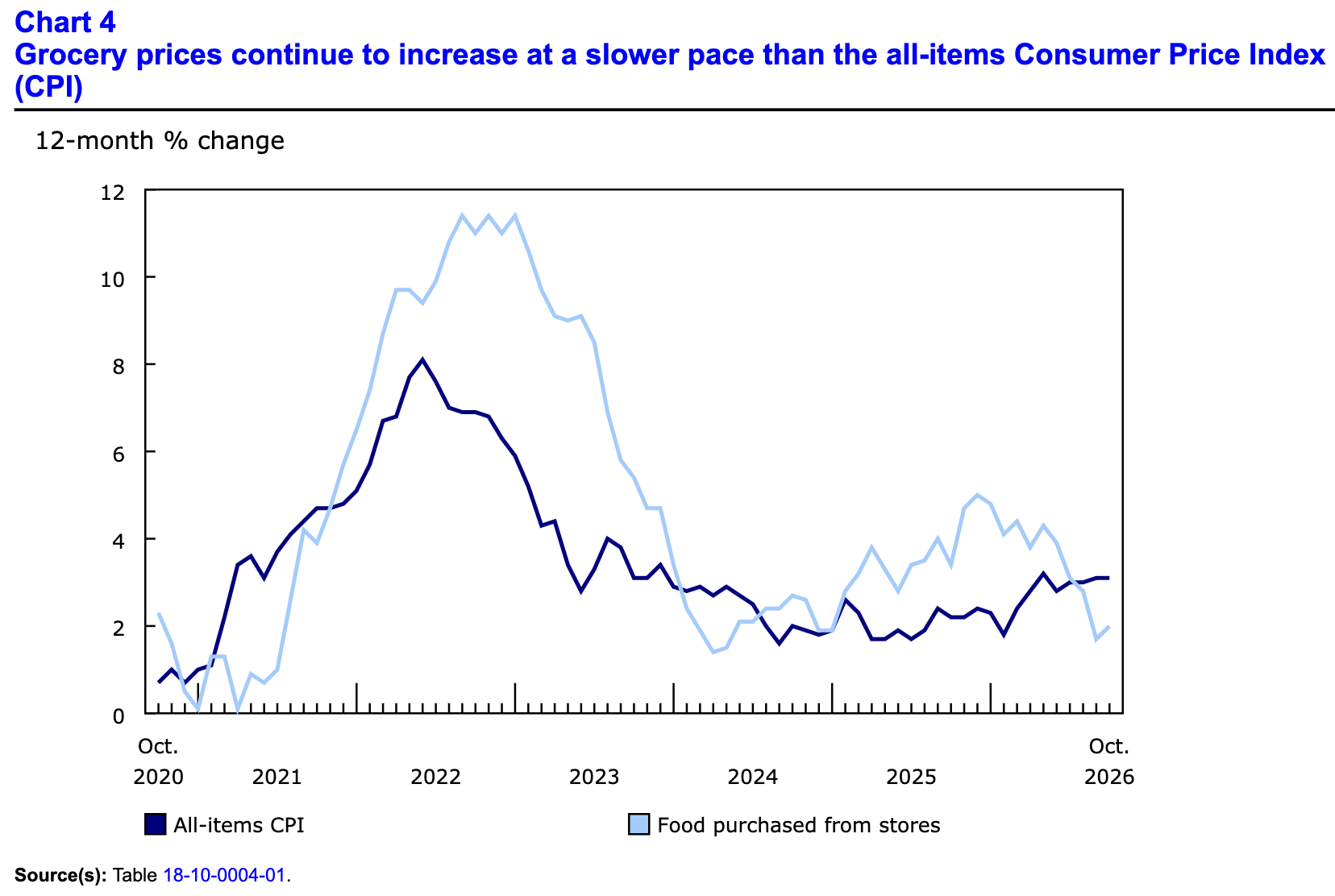
After four straight months of slowing growth, prices for food purchased from stores increased Y-o-Y in October, rising by 2.0% versus 1.7% in September.
Fresh vegetables (+1.4% in October vs. -2.9% in September) helped lead the way, while sugar and confectionery (+0.4%) and condiments, spices and vinegars (+2.6%) were also outperformers.
Despite that, it was the third straight month where grocery inflation rose at a slower pace than the headline CPI.
The Data Dilemma
While Macklem cited a resilient Canadian economy as a reason for less accommodative policy, conflicting data points may make it challenging to maintain that stance.
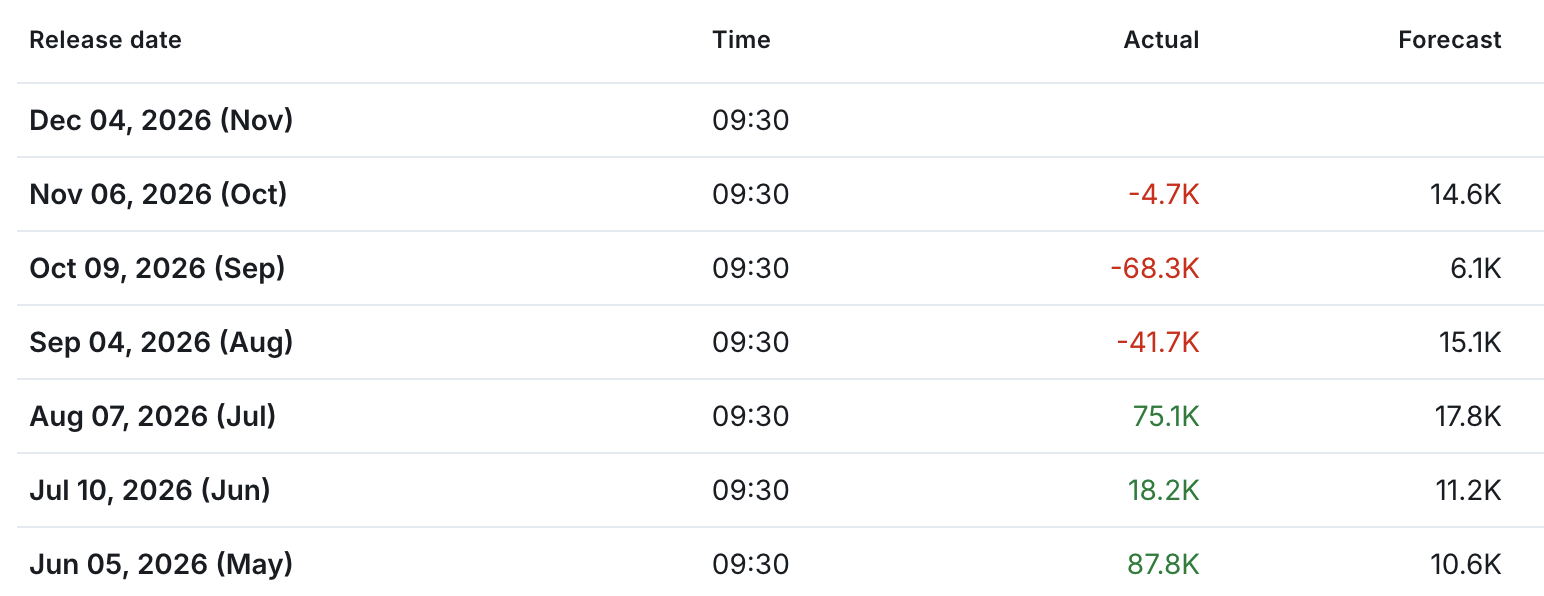
For example, Canada shed another 4,700 jobs in October, and it was the third straight month of net negative performance. As a result, while Canada’s employment data is notoriously volatile, the last three months have been quite poor relative to expectations.
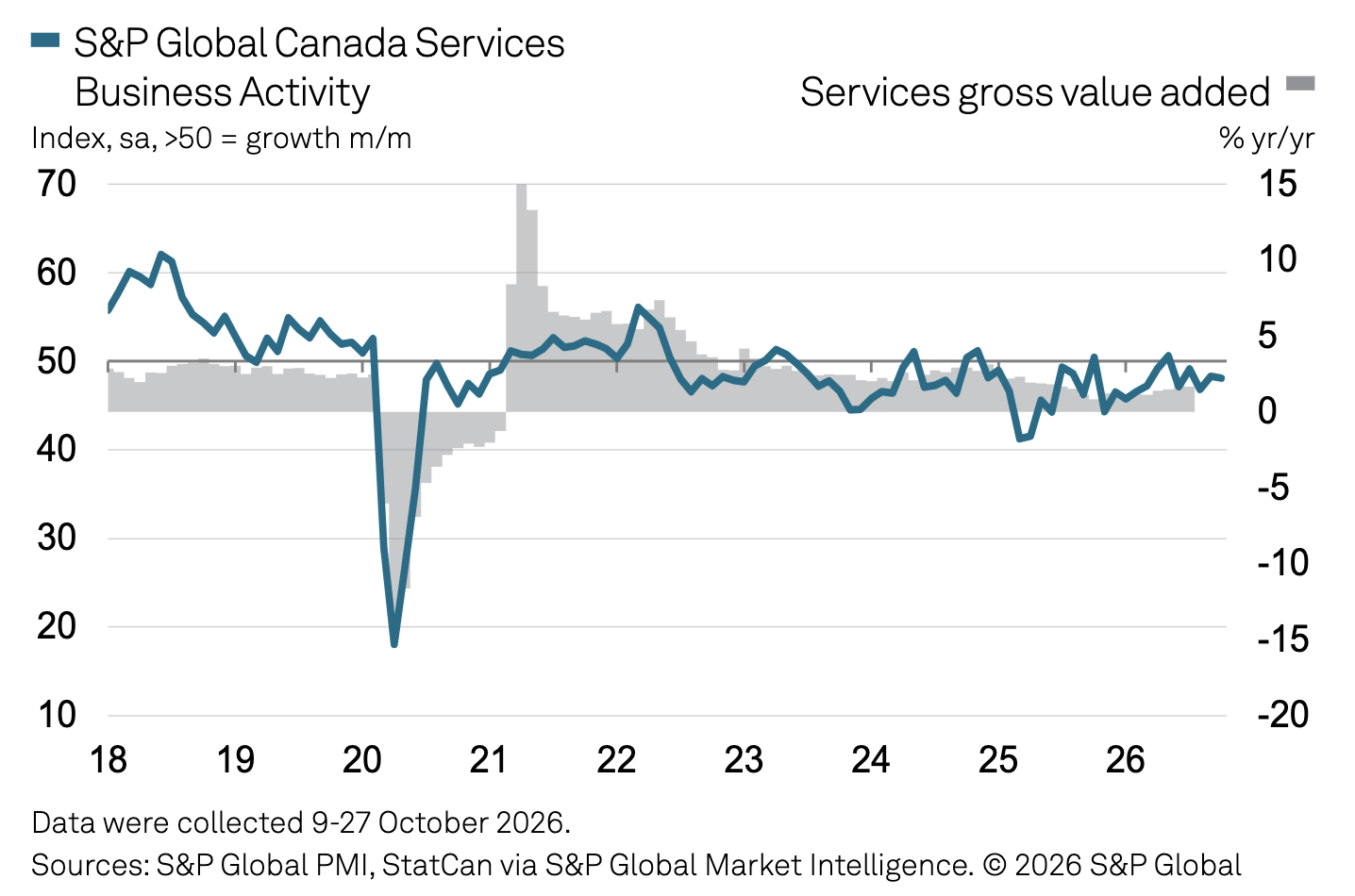
Speaking of which, S&P Global released its latest Canada Services PMI on November 4. The report stated:
“The headline S&P Global Canada Services PMI® Business Activity Index posted below the critical 50.0 no-change mark for a fifth successive month in October to indicate a further deterioration in business activity. The rate of contraction was modest, but slightly faster than September as signalled by a drop in the index to 48.1 in October, compared to 48.3 in the prior month.”
Paul Smith, Economics Director at S&P Global Market Intelligence, added:
“Inflation remains elevated and continued to be driven higher by fuel surcharges, rising transportation costs and tariffs, but efforts to pass these on to clients was again limited by a weak demand environment. No wonder firms again reported a net reduction in employment over the month.”
Therefore, while Macklem remains worried about a repeat of the 2021-2022 inflation spiral, the fundamentals seem different this time around.
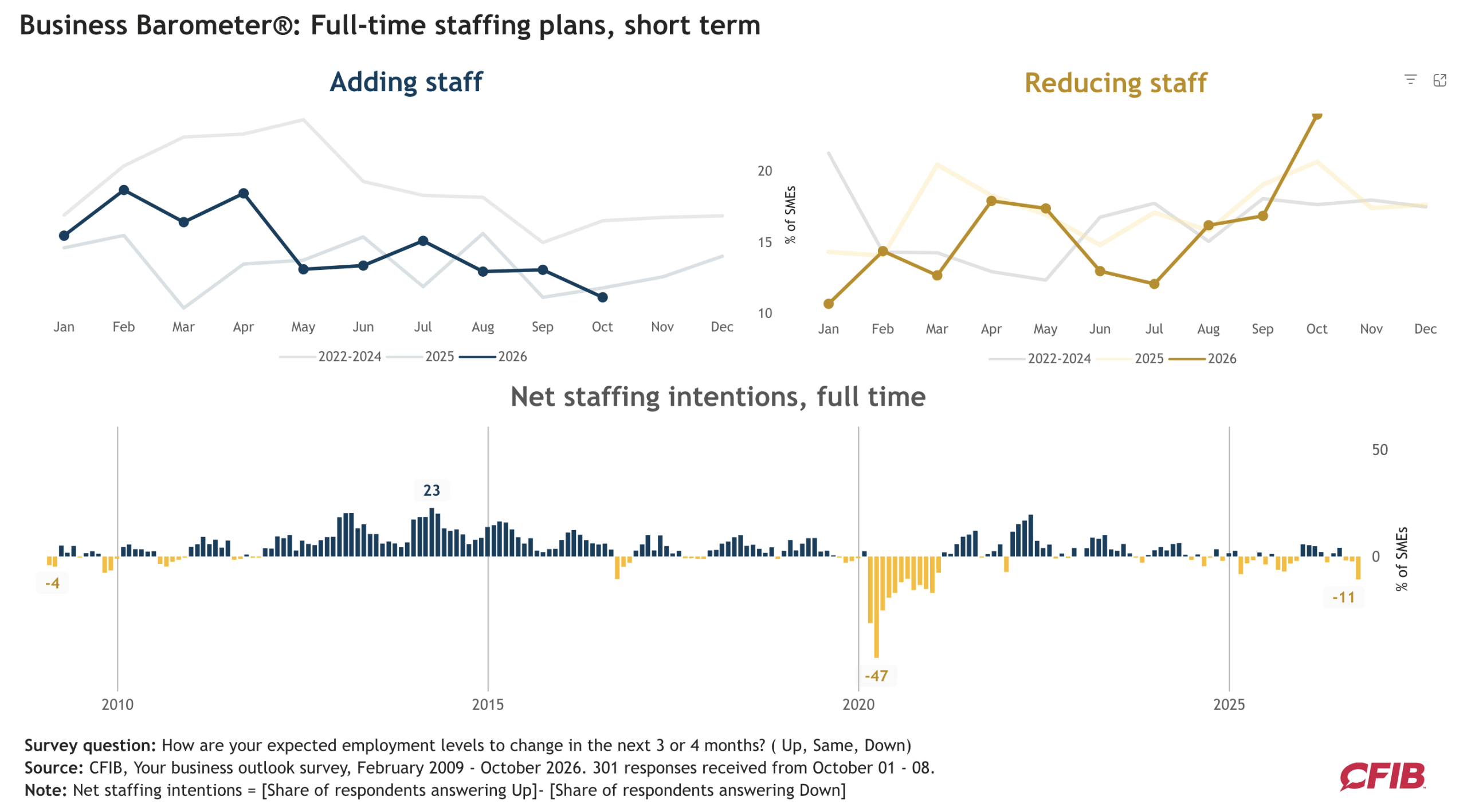
Finally, the latest CFIB Monthly Business Barometer paints a similar portrait. The report — which covers the behavior of Canadian small businesses — noted that SME’s “average price increase edged down to 2.8% in October, a decrease of 0.5 percentage points. The average wage increase decreased slightly to 2.2%.”
In addition, “Full-time staffing plans weakened further in October, with a higher share of employers planning to lay off staff (22%) than to hire (11%). This month marks the weakest net staffing intentions since the pandemic.”
So, as the BoC continues its inflation fight, other variables could create some speed bumps along the way.
Turning to gold, higher interest rates and a stronger US dollar remain headwinds for the yellow metal. And while it seemed like some progress was occurring recently, another rise in rates helped fuel gold’s correction last week.
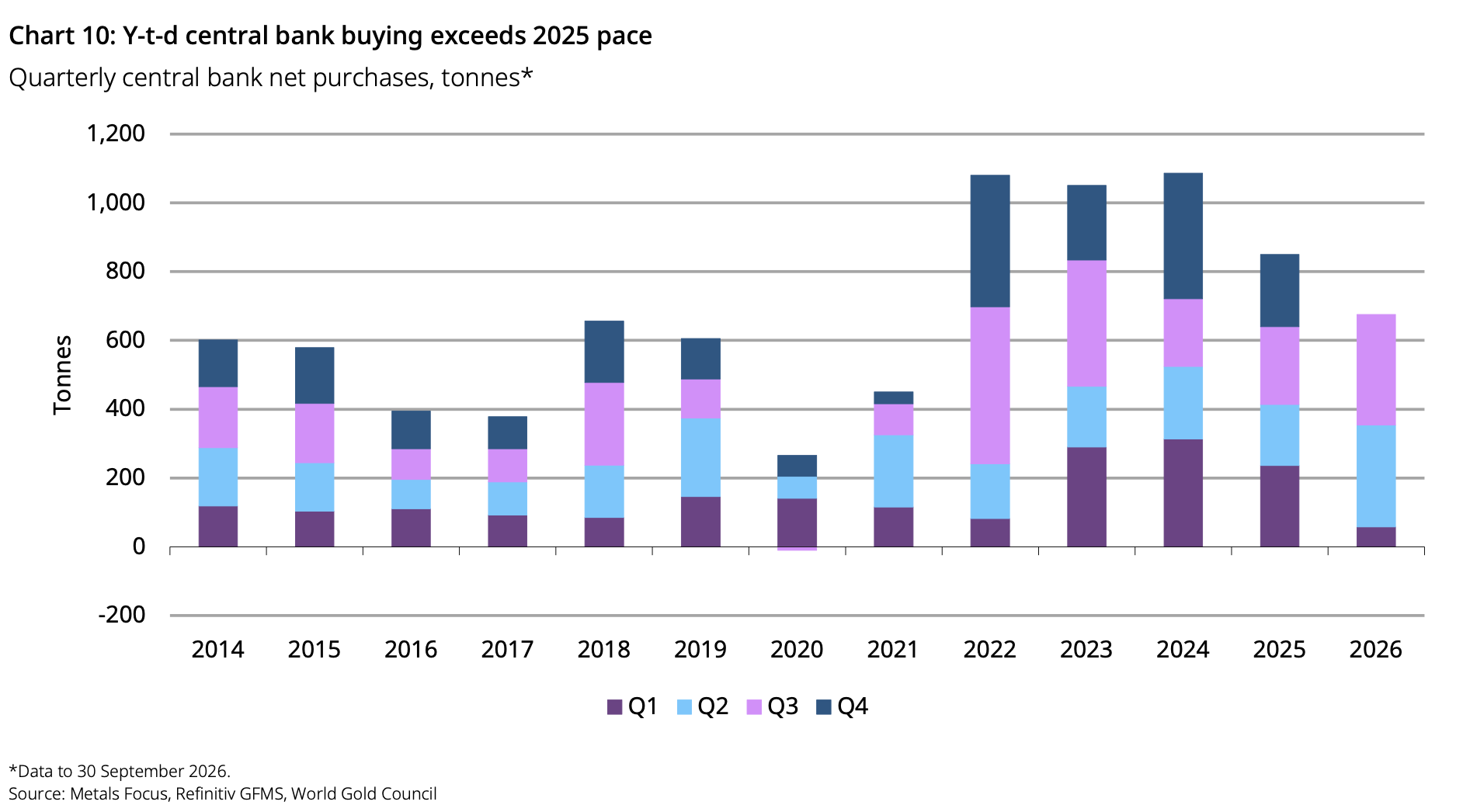
Despite that, the World Gold Council noted in its November 3 report that central banks continue to increase their gold purchases. An excerpt read:
“Central bank demand remained strong in Q3, with net purchases of 321t – above both the solid Q2 total and the five-year quarterly average (227t). The volume of buying in the second and third quarters more than offset a subdued start to the year, lifting y-t-d demand to 675t, 6% above the same period of 2025.”
Moreover:
“The headline total, however, masks a significant gap between reported purchases and estimated demand. Reported net buying amounted to 120t in Q3, compared with total estimated demand of 321t, and was heavily concentrated among a small number of buyers. Unreported activity accounted for around 63% of the quarter’s demand, continuing the pattern evident since 2022. This means that disclosed country-level purchases provide only a partial picture of the underlying sources of demand.”
Thus, with robust enthusiasm still evident from the world’s largest buyers, gold should remain a highly sought-after asset for the foreseeable future.
Dedicating a small portion of one’s TFSA or RRSP portfolio to precious metals may help mitigate some of the geopolitical risks and negative effects of inflation. If you want to get started with investing in metals such as gold and silver, read our free guide to gold buying in Canada in 2026 today.
In addition, with rising interest rates making auto loans less affordable, partnering with the right lender can save you hundreds or thousands of dollars. For bad credit borrowers in BC, Alberta, and Ontario, our extensive guides help empower you with the knowledge and resources to find the right solution. They cover all the angles — the best lenders, hidden costs, optimal tax strategies, and much more.
Furthermore, as economic and labour market uncertainty create challenges for many Canadians struggling to manage debt, seeking professional help can ease the burden.
There are several pathways available — from debt counseling, to management plans, to loans, and even consumer proposals. To determine the right option for you, our provincial breakdowns cover the pros and cons of each and where to find the best resources.
To learn more, please see our guides for Yellowknife & the NWT, PEI, New Brunswick, Nova Scotia, and Manitoba.
For additional resources, please consult our list of reliable lenders to see a wide range of products and services available in your area.

Alex Demolitor is a financial writer hailing from Halifax. Alex has a Bachelors Degree from King's College and passed the CFA Exam Level III. He specializes in fundamental analysis of the stock, bond, commodity, and FX markets. He also covers US & Canadian economic indicators. He has been published on many financial publications, including Investing.com, FXEmpire and others.