
Blue Cross Life (CNW Group/Blue Cross Life)
Most Canadians know Blue Cross for health, dental and travel coverage, but Blue Cross also offers life insurance in Canada through Blue Cross Life Insurance Company of Canada (Blue Cross Life). Its individual life offering is refreshingly simple: term life insurance, sold directly online, underwritten by Blue Cross Life itself. In this review I cover how it actually works, what it costs you in practice, the one relationship the marketing does not put front and centre, and how it stacks up against the two online alternatives I get asked about most.
See what you would actually pay
Life insurance pricing is personal, so the only number worth anything is your own. A Blue Cross Life quote is free, takes a couple of minutes, and does not commit you to anything.
One thing to sort out before anything else. The broader Blue Cross family in Canada is not one company. The Canadian Association of Blue Cross Plans represents seven independent regional plans (Pacific, Alberta, Saskatchewan, Manitoba, Ontario, Quebec and Medavie Blue Cross), plus Blue Cross Life as the national life insurer. Between them they insure roughly 8 million Canadians, and those regional plans are best known for health and dental benefits.
The life insurance covered in this review is different. It is offered by Blue Cross Life Insurance Company of Canada, a federally licensed insurer operating across the country, and it is bought directly through Blue Cross Life’s online platform rather than through a regional Blue Cross plan. Unlike many digital-first insurers that sell policies backed by a third-party underwriter, Blue Cross Life is both the issuer and the underwriter of its individual policies.
Blue Cross Life at a Glance
How Blue Cross Life Compares to the Alternatives
These three all sell online and all three are worth a quote, but they are built for different buyers. I have left advisor-sold distributors like IDC universal life out of this comparison on purpose, since those are placed through an advisor rather than bought directly and it is not an apples-to-apples match.
PolicyMe
★ Best overall
Best for
Healthy term buyers
Underwritten by
Securian Canada
Application
Fully online
Premiums
Level
Coverage
$100K to $5M
Availability
Canada-wide
Blue Cross Life
★ You are reading this
Best for
An established insurer on the policy
Underwritten by
Blue Cross Life
Application
Fully online
Premiums
Level
Coverage
$100K to $5M
Availability
Canada-wide
North Cover
No-underwriting bridge
Best for
Hard to insure, no exam
Underwritten by
Teachers Life
Application
No exam
Premiums
Rise every year
Coverage
Final expense and term
Availability
Canada-wide
All three are sold across the country. You will sometimes see the phrases “all provinces” and “Canada-wide” used interchangeably in insurance marketing, and they mean the same thing here: there is no province or territory where one of these is sold and the others are not.
My quick take: PolicyMe remains my best-overall pick for healthy term buyers. Blue Cross Life is the one to look at when you want a long-established Canadian insurer carrying the risk and you like that it also sells critical illness alongside term. North Cover earns its place only as a bridge for people who cannot get underwritten elsewhere, and you have to go in clear-eyed about premiums that climb every single year.
Blue Cross Life Insurance: Pros and Cons
Pros
- The insurer on the policy is the one taking the risk. Blue Cross Life underwrites its own term and critical illness contracts.
- Part of a Blue Cross family that has been in Canada for more than 80 years and insures around 8 million people.
- Genuinely fast online purchase. The application runs about 20 minutes and some applicants get same-day coverage.
- Level premiums for the whole term, so the first payment is the last payment.
- Five term lengths (10, 15, 20, 25, 30 years) rather than the usual two or three, which makes matching a mortgage payoff much easier.
- Coverage from $100,000 up to $5 million, so it scales with you.
- Fully underwritten, yet many applicants still avoid a medical exam.
- Critical illness is available too, up to $1 million across 44 conditions, which is unusual in the direct-to-consumer lane.
- Couples who apply together can save 10% on first-year premiums.
Cons
- You are not cutting out a middle layer. The online platform is distributed by PolicyMe Corp, which is paid an administration and technology fee on every policy sold.
- No permanent coverage. Whole life and universal life are not part of the direct offering.
- Coverage starts at $100,000, so it is the wrong product for a small final-expense policy.
- No joint policies. Couples buy two individual contracts instead.
- No advisor to sit down with, which some buyers genuinely want for a decision this size.
- No current public financial strength rating. AM Best affirmed an A- (Excellent) rating and then withdrew it in August 2022 at the company’s own request.
- Direct-to-consumer life is still a young line for the brand next to its well-known health, dental and travel coverage.
What Blue Cross Life Actually Sells Online
Term life insurance
Terms run 10, 15, 20, 25 or 30 years, which is a wider ladder than most direct sellers offer. That matters more than it sounds. If you have 22 years left on a mortgage, a 25 year term wastes far less money than being pushed into a 30. Coverage runs from $100,000 up to $5 million and premiums stay level for the whole term, so you can budget around it from day one.
The whole purchase happens online. Blue Cross Life describes a three step process: pull a quote, answer the health and lifestyle questions (about 20 minutes), then review and pay once you are approved. It is fully underwritten, but a lot of applicants never see a paramedical nurse. This is the product most families should price first, and it is the cleanest comparison against our best term life providers in Canada roundup.
Critical illness insurance
Easy to miss, and worth knowing about. Blue Cross Life also sells critical illness cover online, up to $1 million across 44 covered conditions. It pays a lump sum on diagnosis rather than on death, which is a different job entirely. Very few direct-to-consumer platforms in Canada offer both lines in one place.
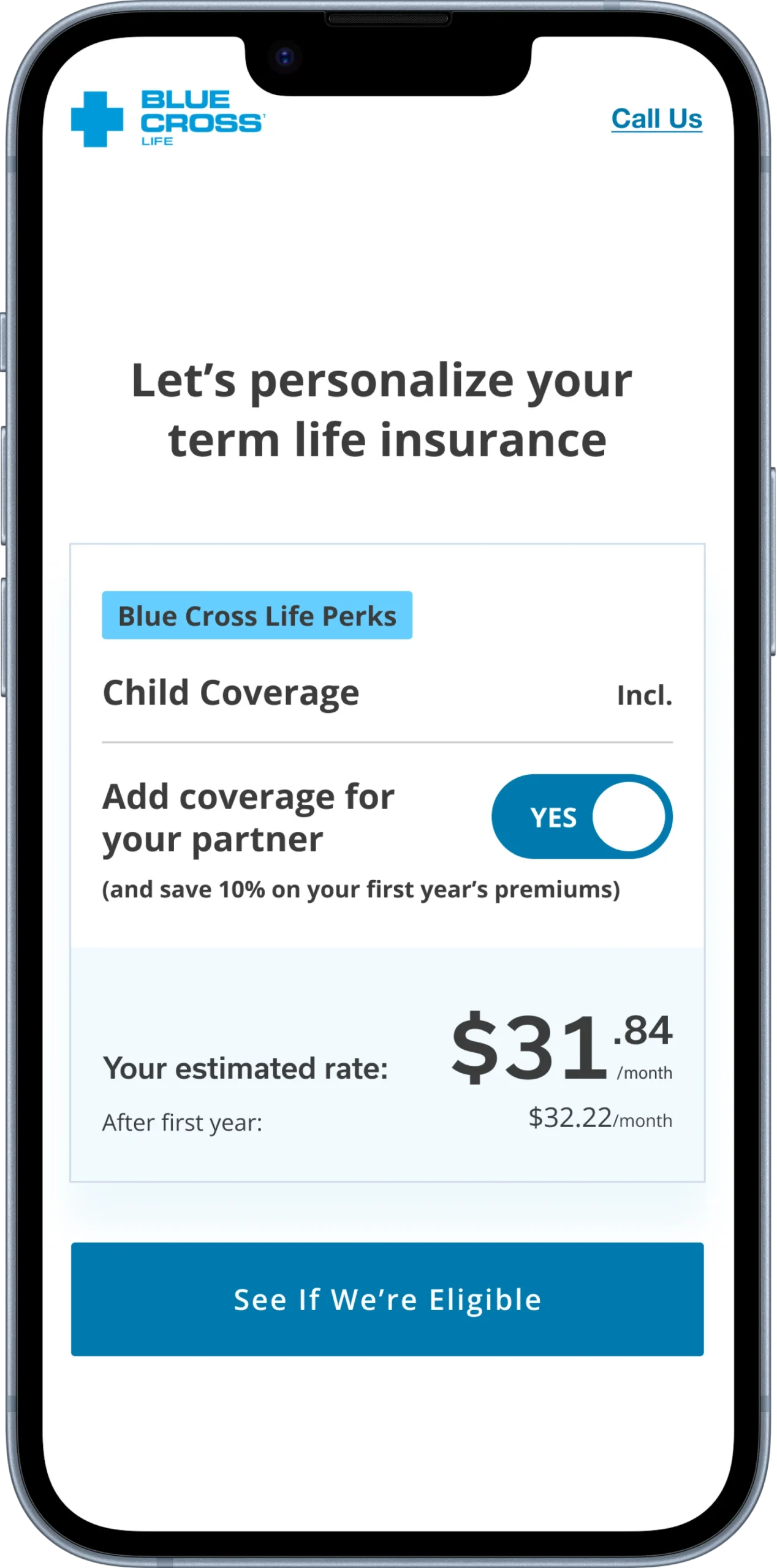
The Blue Cross Life online quote flow
If what you actually want is permanent coverage or a more layered estate structure, that sits outside what Blue Cross Life sells directly. Talk to a licensed advisor and do your homework on estate planning before you commit to a product you will be paying into for decades.
The PolicyMe Connection You Should Know About
Straight from Blue Cross Life’s own site: “Individual Term Life and Critical Illness Insurance products are underwritten by Blue Cross Life and distributed by PolicyMe Corp.” Their about page adds that “PolicyMe Corp. is compensated through an administration and technology fee for each policy sold.”
I have been writing about Canadian life insurance for more than twenty years, and this is the kind of detail that used to live in a paper policy booklet nobody read. It is worth five minutes of your attention. When Blue Cross Life relaunched its digital term product in October 2024, it did so on PolicyMe’s technology, and it put $15 million of equity financing into PolicyMe at the same time. The company said the resulting rates came in roughly 10% below existing offerings in Canada by stripping out application inefficiencies.
So what does that mean for you, practically?
- The underwriting claim holds up. Blue Cross Life carries the risk and pays the claim. That is real and it is not marketing.
- The “no middleman” framing does not. There is a distributor, it is PolicyMe, and it earns a fee per policy. I have seen this described elsewhere as buying direct with nobody in between, and that is simply not accurate.
- It changes how to read the comparison. Blue Cross Life and PolicyMe are not two unrelated rivals. Quote both anyway, because they use different underwriters and the pricing genuinely differs, but do not assume you are sampling two independent corners of the market.
None of this is a reason to walk away. A distributor fee is a normal cost of doing business and it is already baked into the quote you see. It is a reason to stop treating “direct from the insurer” as the deciding factor and to just compare the actual numbers instead.
How Much Does Blue Cross Life Insurance Cost?
There is no published price list, and any site quoting you a firm monthly figure without knowing your age and health is guessing. What I can do is show you which levers move the number and in which direction, so you know what you are trading when you adjust the sliders.
| What you change | Effect on premium | Worth knowing |
|---|---|---|
| Your age at application | Biggest single driver | Every birthday costs you. This is the one variable you cannot get back. |
| Smoking status | Large increase | Most insurers require you to be smoke free for 12 months to requalify at non-smoker rates. |
| Longer term (10 to 30 years) | Higher | You are locking the rate for longer, so you pay for that certainty up front. |
| Higher coverage amount | Higher, but not proportionally | Cost per $1,000 of coverage usually improves as the face amount goes up. Always price the larger amount before you rule it out. |
| Health and family history | Varies | Because this product is fully underwritten, good health is genuinely rewarded here. |
| Applying together as a couple | 10% off year one | Two individual policies, not a joint contract, so each of you keeps your own coverage. |
Level premiums versus premiums that climb
This is the structural difference that trips people up most often, and it is the main reason I place Blue Cross Life above North Cover. A level premium is fixed for the whole term. An annually increasing premium looks cheap on day one and quietly becomes the most expensive thing in your budget by year eight or nine.
Illustrative of policy structure only. Not actual rates from either insurer.
Your rate is the only rate that matters
Age, health and smoking status swing the number far more than any comparison table can. Pull the real figure, then decide.
Who Should (and Shouldn’t) Choose Blue Cross Life
A strong fit if you
- Want a long-established Canadian insurer underwriting your policy
- Value a term ladder with five lengths so coverage matches your actual obligations
- Want term and critical illness quoted in one place
- Are comfortable doing the whole thing online with no appointment
- Want a premium you can budget around for 10 to 30 years
Look elsewhere if you
- Want permanent coverage such as whole or universal life
- Need a small policy under $100,000 for final expenses
- Want a single joint contract with your partner
- Would not get underwritten and need a no-medical option
- Would rather work through a human advisor
Whichever camp you land in, price at least two insurers. It takes about ten minutes total and the spread between quotes for the same person is routinely larger than people expect.
Reputation, Regulation and Who Stands Behind the Policy
Brand recognition is not the same as financial strength, so here is what is actually verifiable rather than what the marketing says.
- Federally regulated. Blue Cross Life is supervised by the Office of the Superintendent of Financial Institutions, which sets and monitors capital requirements for federally licensed insurers.
- Assuris protection applies. Under the Insurance Companies Act, every life and health insurer authorised to sell in Canada must belong to Assuris. If a member insurer failed, Assuris protects death benefits up to $1,000,000 or 90% of the promised amount, whichever is higher.
- The rating picture has a gap. AM Best affirmed Blue Cross Life at A- (Excellent) and then withdrew the rating on 25 August 2022, because the company asked to stop participating in the interactive rating process. That is a routine reason and it is not a downgrade, but it does mean there is no current public financial strength rating to point at.
- Scale. Blue Cross Life sits alongside seven independent regional plans under the Canadian life and health insurance umbrella, and together the family covers roughly 8 million Canadians.
My honest read: the combination of an OSFI-regulated balance sheet, mandatory Assuris membership and eight decades of the Blue Cross name in this country is more than enough comfort for a term policy. I would still like to see a current public rating restored.
Is Blue Cross Life Available in Your Province?
Yes. Because Blue Cross Life is federally licensed and sells through a single national online platform, you do not need to go through your regional Blue Cross plan to buy it. That said, the competitive set you are choosing from does shift by province, and provincial insurers often price certain profiles better. Here is where to see the local field before you commit:
Quebec buyers should note one wrinkle worth checking at quote time: contract language, policy documents and the claims process are handled in French there, and a few national platforms handle that better than others. It is a two minute question to ask before you apply, not a reason to avoid a national insurer.
How to Apply and How a Claim Works
STEP 1
Quote. Age, province, sex at birth and smoking status gets you a personalised premium in seconds.
STEP 2
Apply. Health and lifestyle questions online, roughly 20 minutes. Answer them carefully and honestly.
STEP 3
Activate. Review the policy and make the first payment. Some applicants are covered the same day.
On claims, the beneficiary contacts Blue Cross Life, submits the claim forms and the death certificate, and the benefit is paid tax free to the named beneficiaries once approved.
One piece of advice I have repeated for two decades and will keep repeating: name your beneficiary properly and revisit it after every major life change. The single most common problem I hear about is not a denied claim, it is a policy still naming an ex-spouse, or a benefit paid to an estate because nobody was named at all. That mistake costs families real money in probate, and it takes about four minutes to prevent.
Our Verdict on Blue Cross Life Insurance
Bottom line: Blue Cross Life earns a recommendation. Level-premium term, $100,000 to $5 million, five term lengths, critical illness available alongside, and an established Canadian insurer carrying the risk. In my ranking of the providers I review individually it lands second, behind PolicyMe as the best-overall pick but comfortably ahead of North Cover, mostly because premiums here stay level while North Cover’s flagship structure raises them every year.
The one mark against it is not the product, it is the positioning. Selling this as buying direct with nobody in the middle overstates the case when PolicyMe distributes it for a fee. Judge it on the rate, the term ladder and the underwriter, all three of which hold up well. And do the obvious thing: pull both quotes.
Ready to see your number?
Free, no obligation, and a couple of minutes of your time.
Prefer to compare more broadly first? Browse all of our insurance reviews, or if it is the Blue Cross name that brought you here, our dental insurance comparison covers the side of the brand most Canadians already know.
Blue Cross Life Insurance FAQ
Is Blue Cross a single life insurance company in Canada?
What life insurance products does Blue Cross Life sell online?
Is Blue Cross Life insurance available in my province?
Do Blue Cross Life term premiums increase over time?
Who underwrites Blue Cross Life policies, and who sells them?
How does Blue Cross Life compare to PolicyMe?
Do I need a medical exam to get covered?
What is the oldest age Blue Cross Life will cover?
Can my partner and I buy one joint policy?
Is my money safe if the insurer fails?
How much coverage do I actually need?
We are an independent blog and may earn a commission from some of the providers mentioned, at no extra cost to you. This does not influence our rankings, which are based on product features, pricing, backing and reputation. Product details, including term lengths, coverage limits and eligibility, were verified against Blue Cross Life’s published materials at the time of writing and can change. This article is general information only and is not financial or insurance advice. Confirm current rates and policy details with the insurer before buying.

Mark Turner is a retired financial writer that now enjoys blogging about different financial topics, such as commodities, inflation, debt, retirement, alternative investments and Canadian politics.