
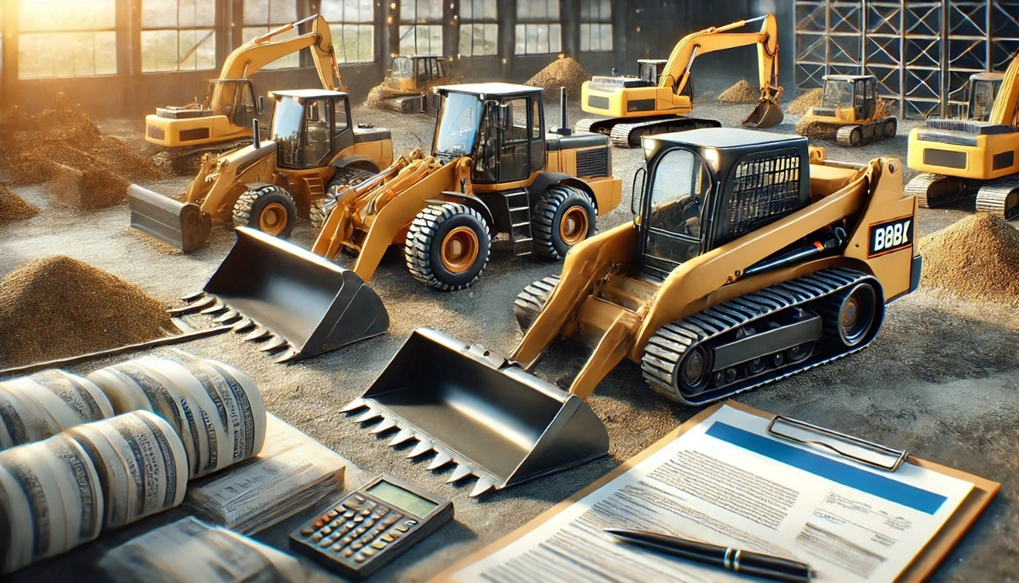
Heavy equipment is expensive, and in construction and related trades you often can’t earn without it. A single excavator, skid steer, or Bobcat can run well into six figures, and buying outright can drain the cash a small or mid-sized business needs for payroll, fuel, and materials. Equipment financing solves that: it lets you put the machine to work and pay for it over time, while preserving working capital for everything else. This guide covers six routes to heavy equipment and construction financing in Canada in 2026 — from the big banks and a government-backed program to alternative lenders that work with weaker credit — plus how to choose and how to improve your odds of approval.
The Pros and Cons of Equipment Financing
Like any borrowing decision, equipment financing has trade-offs worth weighing before you sign.
👍 On the plus side
- It preserves cash flow. Manageable monthly payments keep your working capital intact instead of sinking it into one large purchase.
- It keeps you current. Financing (especially leasing) makes it easier to upgrade to newer, more efficient machines as they arrive, so you’re not stuck running aging equipment.
- It can carry tax advantages. Interest and lease costs may be deductible — check with your accountant, since the treatment depends on whether you lease or buy and how the asset is classified.
👎 On the downside
- It costs more than paying cash. Interest and fees mean the machine’s total cost is higher under financing than an outright purchase.
- Weak credit gets punished. A low credit score can mean elevated rates and a required down payment, which reduces the cash-flow benefit that made financing attractive in the first place.
From my background in finance, the number I’d anchor on isn’t the monthly payment — it’s the total cost of borrowing over the life of the loan, plus any residual or balloon at the end. Two offers with identical monthly payments can differ by thousands once you add up the term and fees. Always compare on the total.
Option 1: The “Big 5” Canadian Banks
The major banks — TD, RBC, CIBC, Scotiabank, and BMO — all finance heavy equipment and construction machinery. They offer the most competitive interest rates, the longest terms, and the largest loan amounts. If your credit and financials are strong, a bank is usually the cheapest option and the right first call. The trade-off is speed and flexibility: bank underwriting is slower and stricter than the alternative lenders below, so if you’re newer, thinner on collateral, or in a hurry, you may need to look further down this list.
Option 2: The Canada Small Business Financing Program (CSBFP)
This is the option the original version of this list left out, and it deserves a spot at the top for equipment buyers. The Canada Small Business Financing Program is a federal program administered by Innovation, Science and Economic Development Canada that doesn’t lend directly — instead, the government guarantees up to 85% of a lender’s losses if you default, which makes banks and credit unions far more willing to say yes to businesses they’d otherwise turn down.
For equipment specifically, the numbers matter. A borrower can access up to $1.15 million in total CSBFP financing, structured as up to $1 million in term loans (of which up to $500,000 can go toward equipment and leasehold improvements) plus a $150,000 line of credit. Any for-profit Canadian business with gross annual revenue of $10 million or less is eligible; farming operations are the main exclusion. You apply through a participating bank or credit union, not the government directly.
There are fees to factor in — a one-time 2% registration fee and a 1.25% annual administration fee — and rates are capped (variable at the lender’s prime plus 3%). Since roughly only 16% of small businesses even know the program exists, simply asking your banker about CSBFP when you sit down can widen your options considerably. For a strong asset like a well-priced used excavator, though, always compare a CSBFP loan against a straight equipment lease — sometimes the lease is faster and cheaper once the program fees are added in.
Option 3: Swoop Funding
Swoop is a funding marketplace rather than a single lender: it matches your business with financing options from a network of providers through one streamlined application, which saves you from applying to lenders one at a time. That makes it a useful starting point for comparing heavy-equipment offers across sizes and credit profiles. I looked at the platform in depth in my Swoop Funding review; as with any broker, confirm the specific lender, rate, and fee before committing.
Option 4: Merchant Growth
Merchant Growth is one of Canada’s established alternative lenders, and it’s a practical option for businesses with less-than-perfect credit that don’t fit a bank’s box. It offers flexible terms and revenue-based structures, with faster decisions than a traditional lender. Rates run higher than bank financing — that’s the cost of the flexibility and speed — so it’s best suited to businesses that can’t wait weeks or don’t yet qualify at a bank.
Option 5: SharpShooter Funding
Toronto-based SharpShooter Funding, operating since 2015, specializes in fast, no-collateral funding for small and medium Canadian businesses. It reports approving over 75% of applications and can fund within 24 to 72 hours, with financing between $1,000 and $300,000. There’s an important structural note here: much of what SharpShooter offers is small business funding and merchant cash advances — you’re selling a slice of future revenue at a discount rather than taking a conventional amortizing loan. That can be fast and accessible with bad credit and no collateral, but the effective cost is often high, so treat it as a speed-and-access tool and read the terms carefully before signing.
Option 6: Journey Capital
Journey Capital rounds out the list with financing aimed at businesses that have poor or no credit. Like the other alternative lenders here, it trades higher rates for accessibility and speed, offering tailored structures for borrowers a bank would decline. It’s a reasonable option when credit is the barrier and you need equipment sooner than a traditional loan would allow.
Good Credit vs. Bad Credit: How Financing Changes
Your credit standing shapes nearly every term of an equipment loan. Here’s how the two ends of the spectrum typically compare:
| Feature | Good Credit | Bad / No Credit |
|---|---|---|
| Likelihood of approval | Higher | Lower, and lender-dependent |
| Interest rates | Lower (roughly 6–15%) | Higher (15–30%+) |
| Approval time | Moderate (1–2 weeks) | Fast (1–3 days) |
| Down payment | Low or none | Often 10–30% |
| Loan terms | Longer (up to ~15–20 yrs on real property) | Shorter (up to ~5 years) |
| Access to traditional lenders | Yes | Limited |
| Loan types available | Broad: term loans, LOCs, CSBFP, leases | Narrower: secured loans, MCAs, microloans |
The pattern is straightforward: strong credit buys you cheaper money, more choice, and better terms; weak credit narrows you toward faster but pricier alternative lenders. If your credit sits in the middle, that’s exactly where a government-backed CSBFP loan can tip a lender from “no” to “yes.”
How to Choose a Lender
When you’re comparing equipment financing offers, weigh these factors rather than fixating on the headline rate:
- Interest rate and total cost. The rate matters, but the all-in cost over the full term matters more.
- Repayment terms. Make sure the payment schedule fits your revenue cycle — construction income can be seasonal.
- Fees. Watch for application, processing, and early-repayment penalties, which quietly add up.
- Eligibility requirements. Some lenders enforce strict credit minimums; others weight business revenue more heavily.
- Speed and equipment type. If you need a specific machine on-site next week, an alternative lender’s 48-hour funding may outweigh a bank’s lower rate.
How to Improve Your Approval Odds
A few steps meaningfully strengthen an equipment financing application:
- Improve your credit first if you can. Lenders check both personal and business credit. My guide to improving your Canadian credit score covers the fastest levers, and understanding the R-rating system helps you read what lenders see.
- Keep clean financials. Lenders review your statements to judge profitability and stability. Consistent revenue and organized books make a strong impression.
- Bring documentation. Have tax returns, recent bank statements, and equipment quotes ready.
- Include a clear use-of-funds case. Spell out how the machine drives revenue — especially important for a CSBFP application or any newer business.
The Bottom Line
There’s a heavy-equipment financing option for almost every Canadian business, whatever your credit looks like. If your credit and financials are strong, start with the big banks for the cheapest money. If you’re close to bankable but not quite there, ask specifically about the CSBFP — it’s the most underused tool on this list and can unlock bank financing you’d otherwise be denied. And if credit is a genuine barrier or you need a machine on-site fast, a marketplace like Swoop or an alternative lender like Merchant Growth, SharpShooter, or Journey Capital can get it done, provided you go in clear-eyed about the higher cost.
Whatever route you take, define your exact need first — new versus used, buy versus lease, how fast you need it — and it’s worth exploring region-specific options too, since Alberta, BC, and Ontario each have their own asset-based lenders and provincial programs. Compare at least two or three offers on total cost before you commit.
FAQ
What credit score do I need to finance heavy equipment?
There’s no universal minimum. Banks want strong personal and business credit for their best rates, but alternative lenders like SharpShooter and Journey Capital approve businesses with bad or no credit, and the CSBFP publishes no fixed score requirement. Weaker credit means higher rates and often a down payment.
Can I finance used equipment?
Yes. Most lenders finance both new and used machinery, and the CSBFP explicitly covers the purchase of new or used equipment. Used gear that’s well-priced and holds value can make an especially strong financing case.
Is leasing or buying better for heavy equipment?
It depends. Leasing preserves cash and makes upgrades easier; buying builds equity in the asset. For a strong, durable machine you’ll use for years, buying (via a term loan or CSBFP) often wins. For equipment you’ll want to replace frequently, leasing can be smarter. Compare the total cost of each.
How fast can I get equipment financing?
Alternative lenders can fund in 24–72 hours. Banks and CSBFP loans typically take one to four weeks, depending on the loan’s size and complexity.
What is the CSBFP and is it a grant?
The Canada Small Business Financing Program is a federal loan-guarantee program, not a grant. You borrow from a participating bank or credit union and repay every dollar with interest; the government simply guarantees most of the lender’s loss if you default, improving your odds of approval.

Mohammed Saqib has a Masters Degree from Wilfrid Laurier University in Waterloo. He has a robust background in accounting and finance. Mohammed started his career three years ago working as an investment analyst at a sell-side firm. He has extensively covered publicly-listed companies using fundamental analysis as the cornerstone of his approach. Mohammed has been published on SeekingAlpha, InvesorPlace, Yahoo! Finance and others.